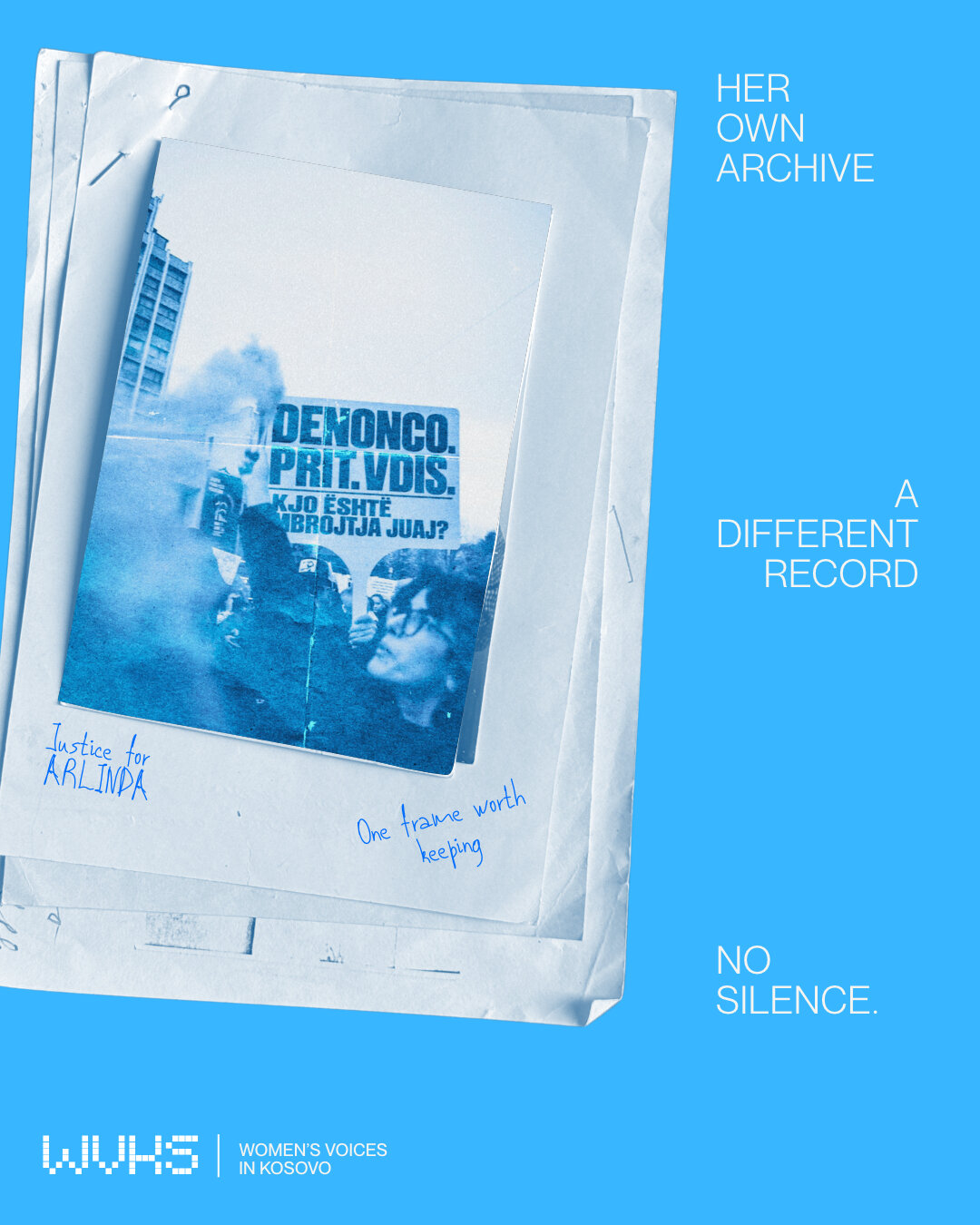
Light blue / archival collage
Poster 07 · Her own archive
A protest photograph kept like a personal record — a different record, and no silence.
Gender Equality and Digital Awareness
A digital awareness and advocacy initiative combining research, visual communication, digital design, and AI-assisted analysis to bring greater visibility to women’s rights and the experiences of women in Kosovo.


These images document public expression and demands for institutional action. They are included as visual context, not as evidence of prevalence or proof of individual case allegations. The first two images were supplied by the user and link to the referenced Telegrafi coverage; the third carries the Pink Movement Kosova credit visible in the image. Please confirm permission and attribution requirements with the original rights holders before public redistribution or commercial use.
Women’s Voices in Kosovo explores how research, digital design, visual storytelling, and responsible technology can make issues affecting women more visible and accessible. It brings together documented information, public advocacy, and creative communication to encourage awareness, dialogue, solidarity, and action around gender equality and women’s rights.
How can research and visual communication help amplify women’s voices, raise awareness of gender inequality, and encourage stronger support for women’s rights in Kosovo?
Research · AI-assisted analysis · Digital design · Visual storytelling · Public awareness
Women’s rights, safety, representation, equality, access to justice, and the social and institutional conditions shaping women’s lives.
Kosovo, with attention to local voices, civil-society work, public institutions, and relevant international frameworks.
Rooted in a Kosovo-Albanian cultural connection and a commitment to making women’s experiences, rights, and perspectives more visible across communities.
A collection of visual campaign directions developed from the initiative’s research themes. Explore the image-led poster series and a typography-only alternative, then use the accompanying AI prompts as creative briefs for further design exploration.
A protest photograph kept like a personal record — a different record, and no silence.
These two data posters draw on the Kosovo Ministry of Justice’s Database for Recording Domestic Violence Cases. The database brings together records from nine institutions, including the Police, Prosecution, Courts, Social Work Centres, victim advocates and shelters, and the Ministry publishes its statistics every three months. Between January and September 2026, 1,626 women and 512 men were recorded as victims of domestic violence, so roughly three in every four victims were women. Over the same period, Police received 2,052 reported cases. The figures show only cases that were officially recorded, so the real extent of violence is likely higher.
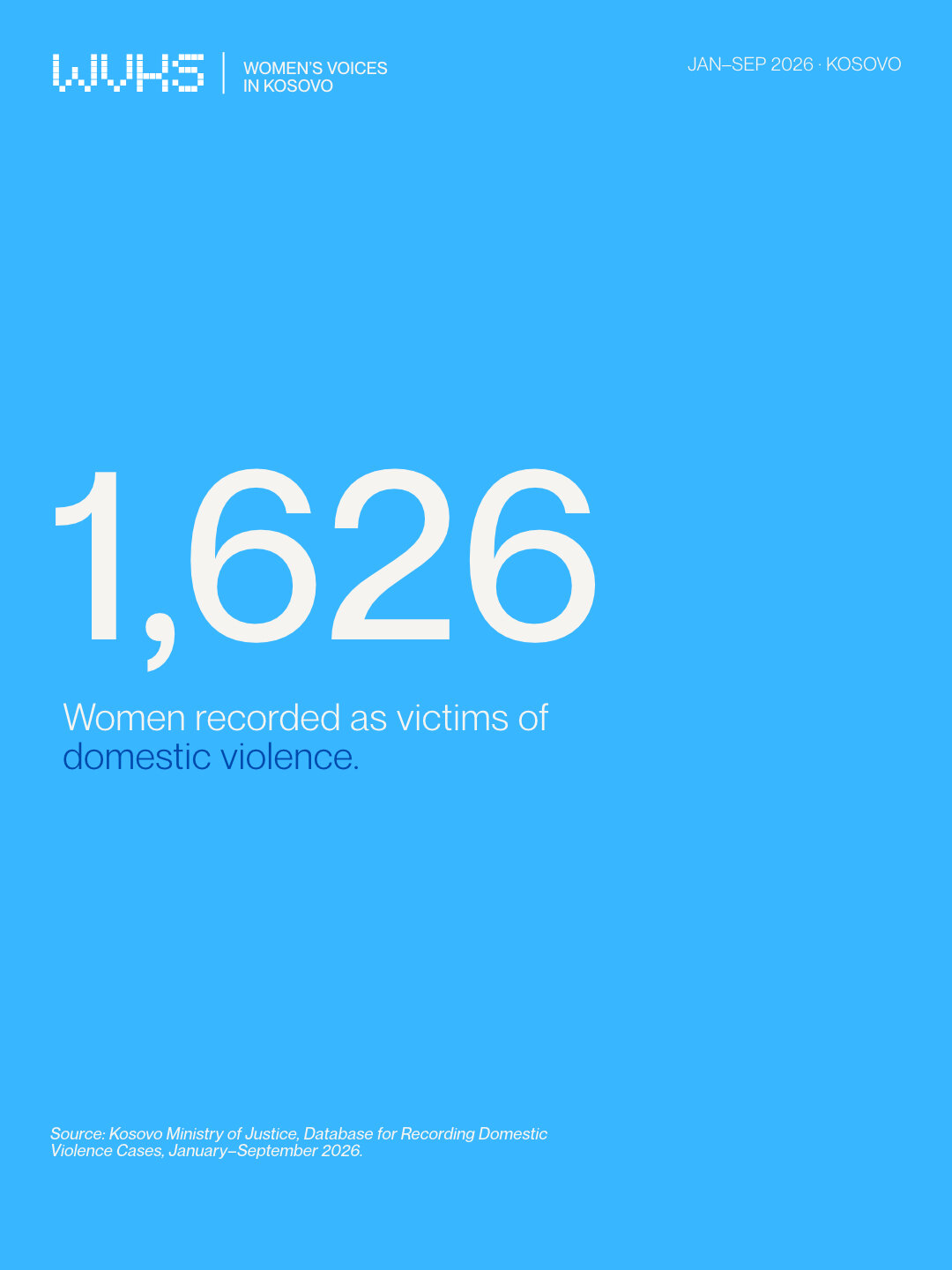
Women recorded as victims of domestic violence from January to September 2026.
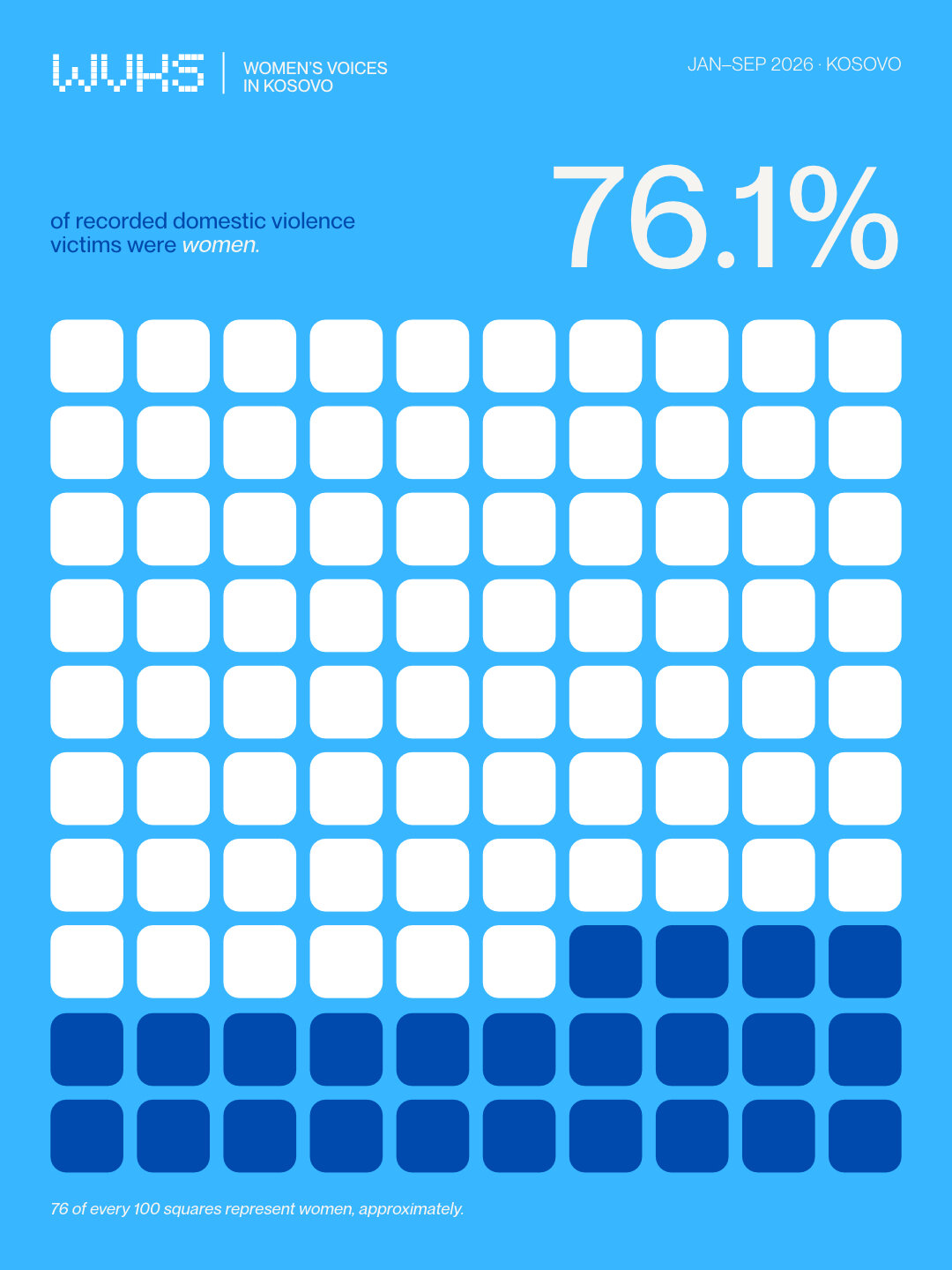
About 76 of every 100 recorded victims were women (1,626 of 2,138).
Source: Kosovo Ministry of Justice — Database statistics on domestic violence.
A second, image-free direction that relies entirely on typography, color, spacing, and abstract geometric forms. The pair uses the same campaign identity while exploring two distinct messages: equal rights and digital safety.
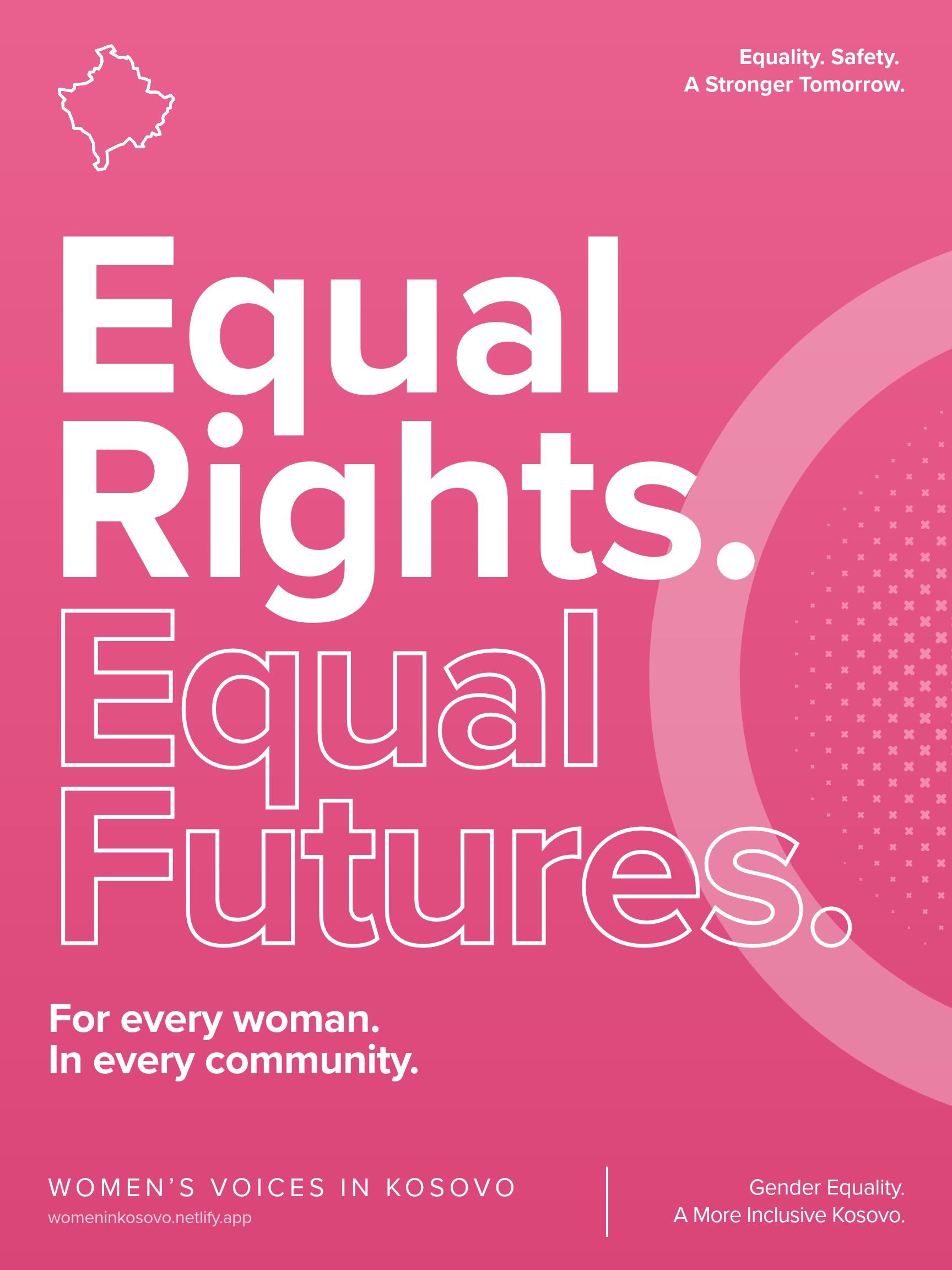
Oversized filled and outlined letterforms with a soft circular motif — for every woman, in every community.
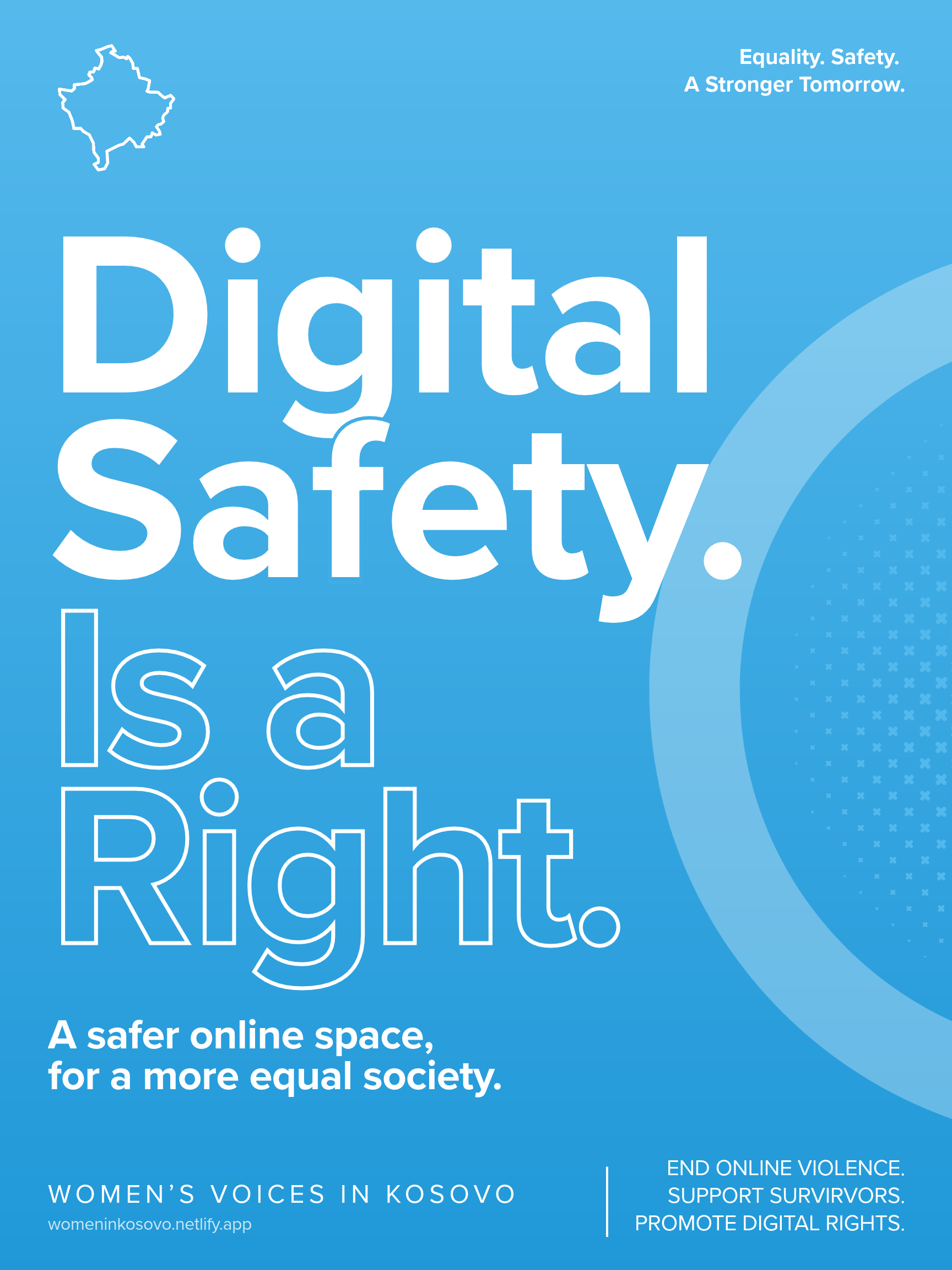
Stacked filled and outlined type with curved geometric linework — a safer online space for a more equal society.
These prompts deliberately prohibit photography, people, icons, and illustrative imagery. The visual impact must come from type, grid, color, and abstract design elements.
Design a premium, typography-only public-awareness poster for “Women’s Voices in Kosovo.”

FORMAT & ART DIRECTION
- Portrait poster, 4:5 ratio, suitable for digital publication and print.
- Use a vivid rose-pink background (#E94F87) with white typography only.
- Absolutely no photographs, people, faces, illustrations, pictograms, flags, or logos.
- Build the composition entirely from typography and abstract geometric design elements: oversized circles, cropped arcs, fine rules, outlined letterforms, and restrained blocks or frames.
- Use a contemporary bold sans-serif with deliberate contrast between heavy filled type and large outlined type.
- Establish a strong editorial grid, intentional asymmetry, generous negative space, and precise alignment. Keep all text legible and balanced.
- Make the headline the dominant visual element; use geometric forms as supporting structure, not decoration for its own sake.

EXACT POSTER COPY — reproduce verbatim:
EQUAL RIGHTS.
EQUAL FUTURES.
For every woman. In every community.
WOMEN’S VOICES IN KOSOVO

Do not add statistics, quotations, extra slogans, or institutional endorsements. No imagery of any kind. Ensure every word is spelled correctly and clearly readable.
Create a clean, high-impact typography-only awareness poster for “Women’s Voices in Kosovo.”

FORMAT & ART DIRECTION
- Portrait poster, 4:5 ratio, suitable for social media and print.
- Use a light UN-inspired blue background (#269ED6) with white typography as the primary color. A very dark navy may be used sparingly for one typographic phrase to create contrast.
- Absolutely no photographs, people, faces, illustrations, icons, devices, flags, or logos.
- Use only type and abstract geometry: oversized cropped circles, thin curved lines, intersecting arcs, subtle framing devices, and carefully placed rules.
- Use a bold contemporary sans-serif with oversized headline typography, purposeful line breaks, and a clear hierarchy between headline, supporting sentence, and footer.
- Organize the layout on a disciplined editorial grid with generous negative space. The result should feel confident, modern, and professionally art-directed—not like a generic template.

EXACT POSTER COPY — reproduce verbatim:
DIGITAL SAFETY
IS A RIGHT.
A safer online space for a more equal society.
END ONLINE VIOLENCE.
SUPPORT SURVIVORS.
PROMOTE DIGITAL RIGHTS.
WOMEN’S VOICES IN KOSOVO

Do not add statistics, quotations, fake interface elements, legal claims, or institutional endorsements. No imagery of any kind. Keep the copy accurate, readable, and correctly spelled.
This pair explores a more typographic identity: the pink poster uses filled and outlined letterforms; the blue poster uses oversized stacked type and curved geometric linework. Both can be rebuilt as editable vector artwork in Illustrator for precise spacing, accessible contrast, and final production.
A coordinated set of digital awareness posters using a repeating pink / light blue color sequence, white typography, strong editorial hierarchy, and concise calls to awareness.

Her Voice Matters — a campaign about women’s visibility, representation, and participation.

Safety Is a Right — a survivor-centred message about support and challenging gender-based violence.

Equal Rights. Equal Futures. — education, work, leadership, and opportunity.

Digital Safety Is Everyone’s Right — privacy, online abuse awareness, and collective responsibility.
Each prompt gives an image-generation model a clear design brief: format, palette, typography, composition, message, and ethical boundaries. Use them as starting points, then refine the final typography, spacing, and accessibility manually in your design software.
Create a professional public-awareness poster for the initiative “Women’s Voices in Kosovo.”

FORMAT & ART DIRECTION
- Portrait poster, 4:5 ratio, designed for a digital campaign and adaptable to print.
- Solid vivid rose-pink background (#E94F87). All typography must be white.
- Contemporary editorial graphic design: minimal, confident, human, and visually striking. Avoid generic NGO-template styling.
- Use a disciplined grid, strong negative space, intentional asymmetry, and a clear typographic hierarchy.
- Pair a large, expressive but dignified photographic portrait of an adult woman with typography. The portrait should feel authentic and respectful, not stereotyped or sensationalized.
- Use a bold modern sans-serif headline, carefully controlled line breaks, readable supporting text, and a small footer signature: “WOMEN’S VOICES IN KOSOVO.”

EXACT POSTER COPY — reproduce verbatim:
HER VOICE MATTERS.
Representation is part of equality.
WOMEN’S VOICES IN KOSOVO

Do not add statistics, quotations, logos, flags, or claims. Keep every word legible and correctly spelled. The design should communicate visibility, agency, and representation.
Create a professional public-awareness poster for “Women’s Voices in Kosovo.”

FORMAT & ART DIRECTION
- Portrait poster, 4:5 ratio.
- Solid light UN-inspired blue background (#269ED6). All typography must be white.
- Clean contemporary editorial design with a strong grid, purposeful negative space, and an intentional balance between image and type.
- Use a symbolic, respectful image of one person offering support to another (for example, hands joined or a supportive gesture). Do not depict physical violence, injuries, fear, or an identifiable survivor.
- Set the headline in a bold modern sans-serif with confident scale and precise line breaks. Supporting copy should be smaller but highly readable.
- Include a discreet footer signature: “WOMEN’S VOICES IN KOSOVO.”

EXACT POSTER COPY — reproduce verbatim:
SAFETY IS A RIGHT.
Recognize harm. Support survivors. Challenge violence.
WOMEN’S VOICES IN KOSOVO

Do not invent hotline numbers, statistics, legal claims, or institutional endorsements. No logos or extra copy. Prioritize dignity, solidarity, and clarity.
Design a polished campaign poster for “Women’s Voices in Kosovo,” focused on equal opportunity and women’s participation.

FORMAT & ART DIRECTION
- Portrait poster, 4:5 ratio.
- Solid vivid rose-pink background (#E94F87). All typography must be white.
- Minimalist, high-impact graphic design with an editorial art-direction sensibility: strong typographic scale, intentional alignment, generous negative space, and a clear visual focal point.
- Use a contemporary portrait or a restrained abstract visual suggesting education, leadership, work, and forward movement. Show an adult woman with agency and confidence; avoid clichés and stereotypes.
- Use a bold geometric or neo-grotesque sans-serif headline. Supporting text should be arranged in a compact, well-spaced block.
- Add a small footer signature: “WOMEN’S VOICES IN KOSOVO.”

EXACT POSTER COPY — reproduce verbatim:
EQUAL RIGHTS.
EQUAL FUTURES.
Education. Work. Leadership. Opportunity.
WOMEN’S VOICES IN KOSOVO

No invented facts, statistics, quotes, flags, or logos. Keep all copy accurate, legible, and correctly spelled.
Create a contemporary digital-awareness poster for “Women’s Voices in Kosovo,” focused on women’s safety and rights in online spaces.

FORMAT & ART DIRECTION
- Portrait poster, 4:5 ratio.
- Solid light UN-inspired blue background (#269ED6). All typography must be white.
- Professional, clean visual communication with an editorial grid, deliberate typography, strong hierarchy, and generous negative space.
- Use a simple symbolic visual: a smartphone, abstract privacy interface, protective frame, or digital signal motif. Avoid depicting harassment messages, exposing personal data, or using frightening imagery.
- Headline in a bold modern sans-serif; supporting copy in a smaller, highly readable size. Keep the composition balanced and suitable for social media and print.
- Include a discreet footer signature: “WOMEN’S VOICES IN KOSOVO.”

EXACT POSTER COPY — reproduce verbatim:
DIGITAL SAFETY IS EVERYONE’S RIGHT.
Protect privacy. Challenge online abuse. Stand together.
WOMEN’S VOICES IN KOSOVO

Do not fabricate statistics, quotes, legal claims, or support contacts. Do not add logos or institutional endorsement. Keep the message empowering, clear, and accessible.
Palette sequence: pink, light blue, pink, light blue. The four posters share a consistent campaign signature while giving each topic its own visual focal point. AI-generated imagery is a concept draft; review and typeset final copy manually to ensure exact wording, legibility, contrast, and accessible reading order.
Research provides context for public awareness and campaign development. The figures and sources below are selected documentary references, not a complete picture of women’s experiences. Dates, definitions, and limitations should always remain visible when information is communicated.
AP reported thousands protesting in Pristina after Zekaj’s killing, with activists raising concerns about institutional coordination and protection. The article cites 2,815 police reports in 2025.
Read Associated Press report ↗Kosovo Women’s Network outlines demands including a Femicide Watch, more social workers, gender-responsive budgeting, stronger case management and institutional accountability.
Read Kosovo Women’s Network recommendations ↗Provides a gender-equality baseline, including the 54% intimate-partner violence survey finding and 2022 administrative indicators. These are dated reference points, not 2026 figures.
Read the country profile ↗Documents shelter capacity, likely underreporting, barriers linked to fear and financial insecurity, and concerns raised by protests following femicides in 2024.
Read civil-society report ↗KOHA reports a 14-point resolution covering investigation of institutional responsibilities, high-risk case reviews, services, legal aid, education and data sharing.
Read KOHA report ↗DW reports on protests and scrutiny of police and prosecutorial actions. Case details remain allegations and reported findings; this pilot does not adjudicate individual responsibility.
Read Deutsche Welle report ↗The initiative organizes research into connected themes so that complex issues can be explored carefully and communicated clearly. Public reports, institutional material, civil-society research, and documented advocacy help establish context and identify questions that deserve greater attention.
| Research theme | Questions to explore | Potential sources |
|---|---|---|
| Prevention | Are prevention commitments funded, delivered and monitored? | Strategies, budgets, education programmes, public communications |
| Protection | Are risk assessments, protection orders and referrals timely and coordinated? | Public monitoring, protocols, aggregate administrative data |
| Access to justice | Are legal aid, investigation and judicial processes accessible and responsive? | Aggregate justice data, oversight reports, civil-society monitoring |
| Institutional coordination | Are responsibilities clear across police, courts, prosecutors and social services? | Referral procedures, mandates, parliamentary scrutiny, audit findings |
| Survivor-centred services | Are shelter, psychosocial, legal and economic supports accessible and adequately resourced? | Service directories, budgets, shelter capacity reports, consultation summaries |
| Accountability | Are gaps investigated, corrective actions assigned and progress disclosed? | Oversight recommendations, action plans, public progress reporting |
Documented source A claim explicitly supported by a cited public document.
Reported claim A claim attributed to a media outlet or stakeholder and not independently verified here.
Analytical question A hypothesis to test, not a finding.
Public sources are uneven and may use different definitions, periods and denominators. Media cases and protests are not representative samples. Missing data is not evidence that an activity did not occur. No interviews or survivor records are used in this pilot.
AI can serve as a supporting system that connects research, analysis, campaign development, and visual communication. It can help organize large amounts of public information, surface recurring themes, suggest questions and campaign directions, and assist with the translation of verified findings into accessible visual content. Human judgment, source verification, and responsible representation remain essential at every stage.
Collect and organize public reports, statistics, publications, institutional material, and documented advocacy related to women’s rights in Kosovo.
Use AI to extract relevant information, summarize documents, identify recurring themes, compare perspectives, and flag gaps or contradictions for review.
Translate verified research themes into awareness topics, campaign messages, educational angles, and creative directions.
Develop infographics, editorial layouts, social media content, visual identities, and digital storytelling that make information accessible.
Check sources, context, language, privacy, accessibility, representation, and the potential impact of every message before publication.
Share research-informed campaigns and resources that encourage discussion, solidarity, learning, and engagement with women’s rights.
AI outputs are working drafts, not verified findings. Source checking, editorial decisions, and final campaign approval remain human responsibilities.
A structured collection of public reports, statistics, institutional resources, civil-society publications, and documented perspectives.
Reusable prompts and workflows for document summaries, theme identification, source comparison, campaign brainstorming, and human verification.
Evidence-informed campaign concepts, educational social content, digital posters, infographics, and visual storytelling centered on women’s rights.
Accessible visual explainers and curated resources that help audiences understand key issues, find further information, and engage with advocacy.
0 of 8 checks completed
Campaigns translate documented issues into clear, respectful, and accessible public communication. Each concept should be grounded in reliable sources, avoid exposing survivors, and invite audiences to learn more and engage constructively.
A visual storytelling series highlighting women’s participation, leadership, achievements, and calls for equality through carefully sourced stories and public voices.
Accessible educational content explaining forms of gender-based violence, respectful ways to support survivors, and routes to verified local resources.
Infographics and explainers that make institutional responsibilities, legal protections, public commitments, and civil-society recommendations easier to understand.
The initiative can draw on the work, research, and public resources of Kosovo civil-society organizations, women-led organizations, public institutions, UN Women, and other international partners working to advance women’s rights. The United Nations and UN Women contribute through research, advocacy, frameworks, and support for gender equality efforts around the world. References to these organizations should be clearly attributed and must not imply endorsement or partnership unless formally established.
Use traceable sources, preserve dates and context, distinguish reported claims from established findings, and correct errors transparently.
Do not identify survivors without informed permission, reproduce graphic details for shock value, or use personal stories as campaign material without consent.
Use AI to assist research and creative exploration, not to fabricate testimony, infer personal risk, determine credibility, or replace the perspectives of women.
Use clear language, readable typography, meaningful image descriptions, accessible contrast, and formats that work across digital platforms.